
Beyond the Firecracker Escape: Why BoxLite’s Network Architecture Matters


A VM’s security boundary includes its network path. BoxLite’s default user-space networking makes a consequential difference.
When news of a virtual-machine escape breaks, attention naturally turns to the hypervisor. For teams running AI agents that execute untrusted code, the immediate question is practical: could this affect our sandbox too?
PWN.AI’s PwnEscape research points to a component outside the hypervisor: the Linux host networking stack. That makes the network architecture an essential part of the discussion—and explains why BoxLite’s default networking follows a different path. PWN.AI technical writeup, BoxLite networking documentation.
The attack surface behind the headline
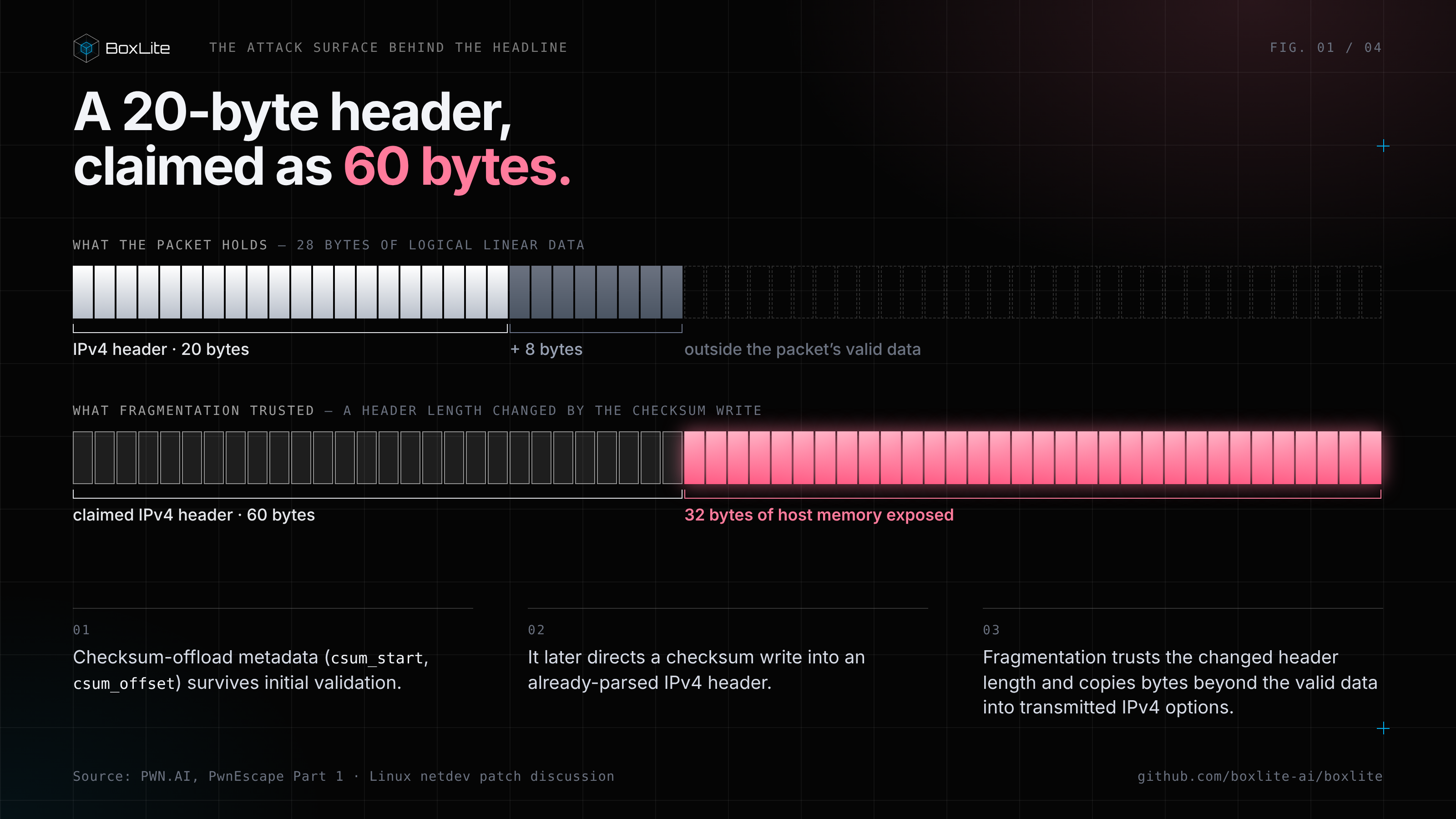
Virtual networking can pass both packet bytes and checksum-offload metadata to the host. Linux uses that metadata to defer checksum calculation, with csum_start and csum_offset identifying where computation begins and where its result will be written. Linux checksum-offload documentation.
The vulnerability involved metadata that could survive initial validation and later direct a checksum write into an already-parsed IPv4 header. Fragmentation then trusted the changed header length and could copy bytes beyond the packet’s valid logical linear data into transmitted IPv4 options. The public patch discussion explicitly notes that a TUN interface with virtio-net header support can reach this path without a VM. Input-validation discussion, Fragmentation patch.
In the researchers’ example, a 20-byte header became a claimed 60-byte header while the logical linear packet data contained 28 bytes, exposing 32 bytes of host memory. PWN.AI technical writeup.
What the published research demonstrates
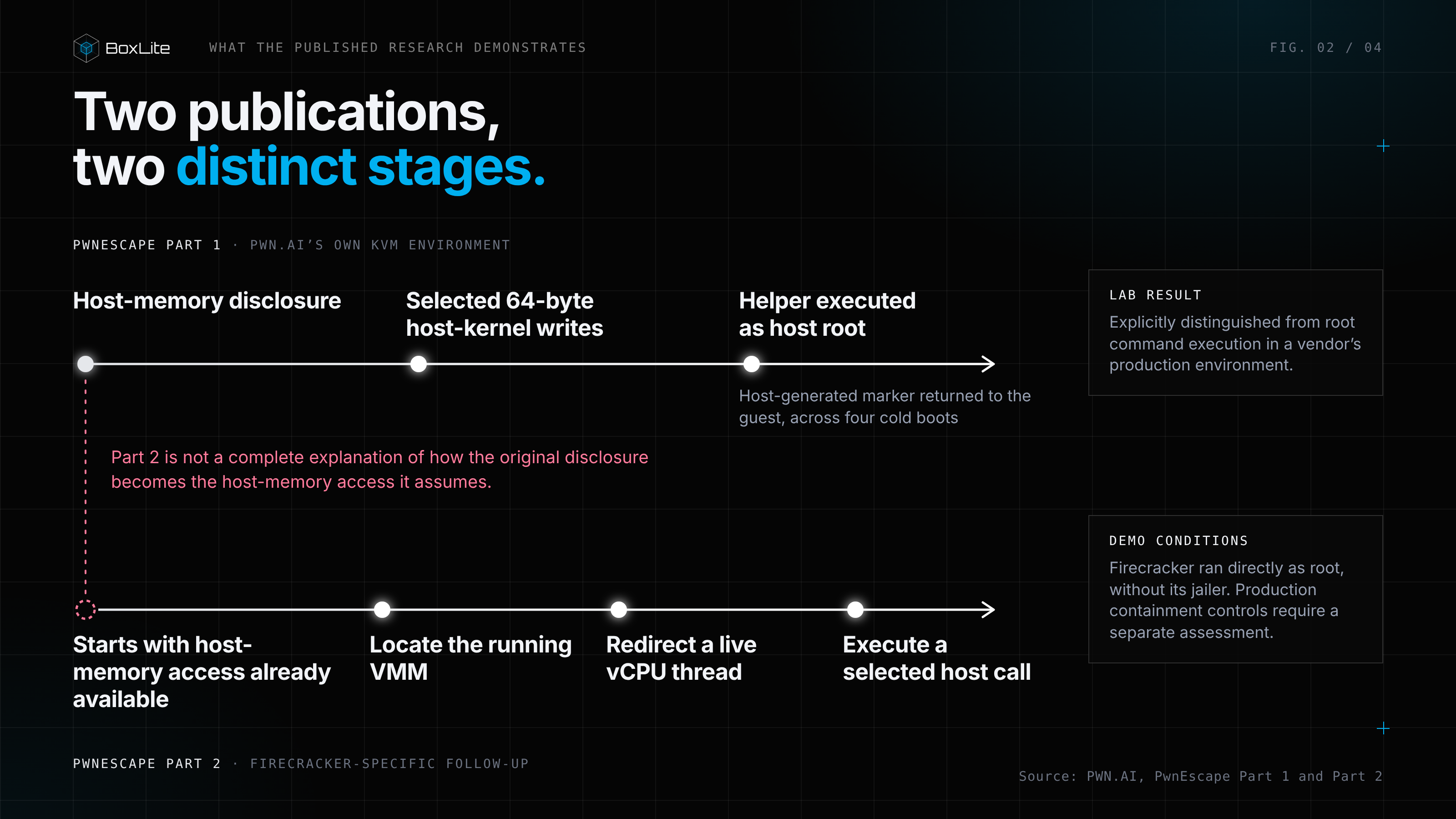
In Part 1, PWN.AI reports progressing from host-memory disclosure to selected 64-byte host-kernel writes in its own KVM environment. Its laboratory chain executed a helper as host root and returned a host-generated marker to the guest, succeeding across four cold boots. The article explicitly distinguishes this result from root command execution in a vendor’s production environment. PwnEscape Part 1.
PWN.AI has since published a Firecracker-specific follow-up. Starting with host-memory access already available, Part 2 describes how the researchers located the running VMM and redirected a live vCPU thread to execute a selected host call. The demonstration ran Firecracker directly as root without its jailer, so the controlled call executed with root privileges. Deployments using Firecracker’s production containment controls require a separate assessment. PwnEscape Part 2.
These publications describe distinct stages of the research. Part 2 explains the Firecracker takeover stage; it should not be read as a complete explanation of how the original disclosure becomes the host-memory access that stage assumes. When assessing another sandbox, both the network entry mechanism and the conditions required by later stages matter.
Why BoxLite’s default path is different
BoxLite uses gvproxy by default, providing user-mode networking based on gVisor’s network stack. Guest packets are processed in user space, and external connectivity is provided through host-side connections. BoxLite networking documentation.
The host kernel still handles networking, but the original guest packets and their checksum-offload metadata are not simply injected into its native packet-processing path. Instead, gvproxy interprets guest traffic and uses ordinary host sockets to communicate with external endpoints. gvproxy project documentation.
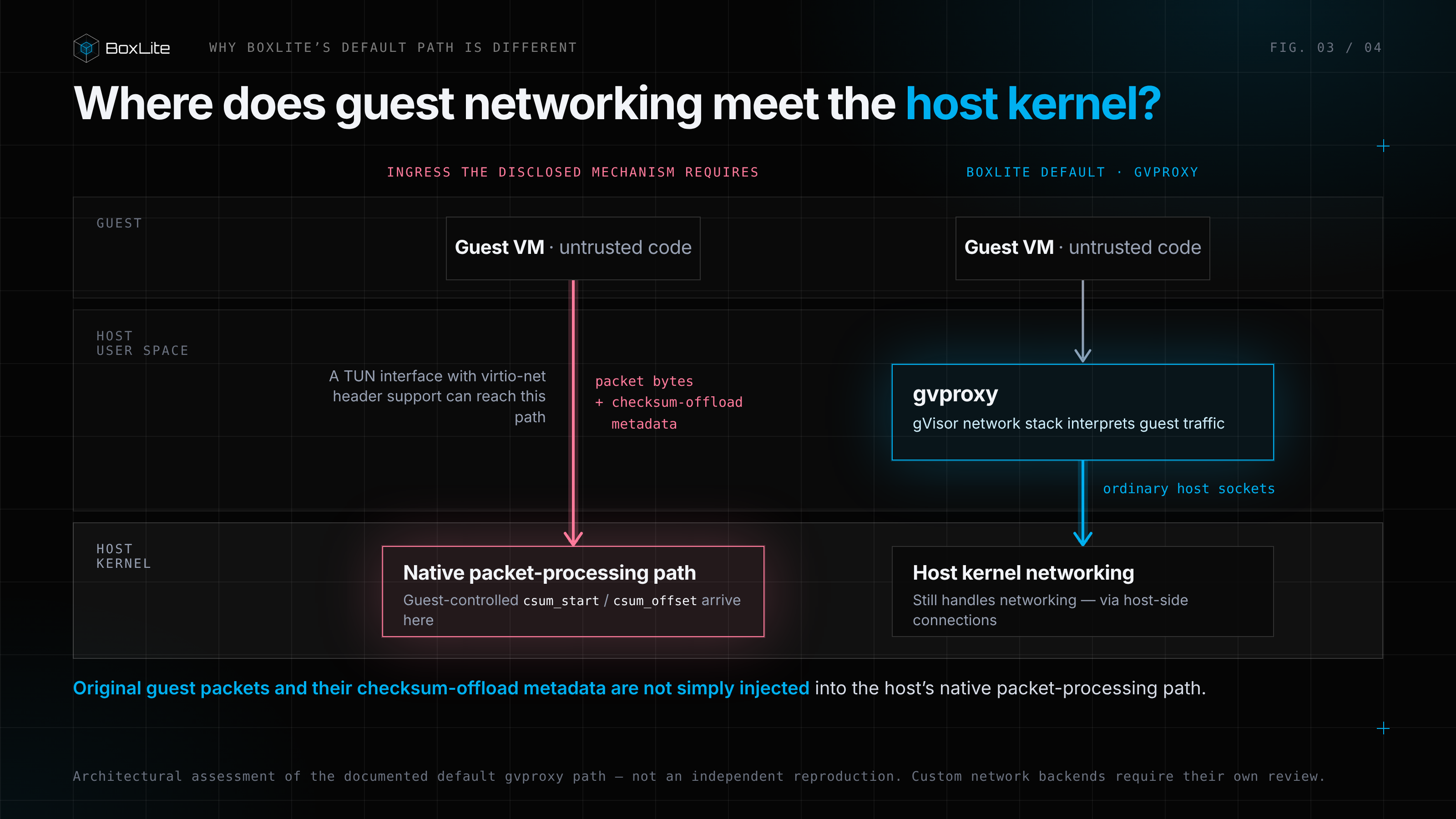
Our architectural assessment is that BoxLite’s documented default gvproxy path avoids the guest-controlled checksum-metadata ingress required by the disclosed mechanism.
This assessment applies to the default gvproxy architecture. BoxLite supports pluggable network backends; custom configurations require their own review. It is an architectural assessment, not a claim that we independently reproduced the researchers’ full exploit chain.
The kernel fix still matters
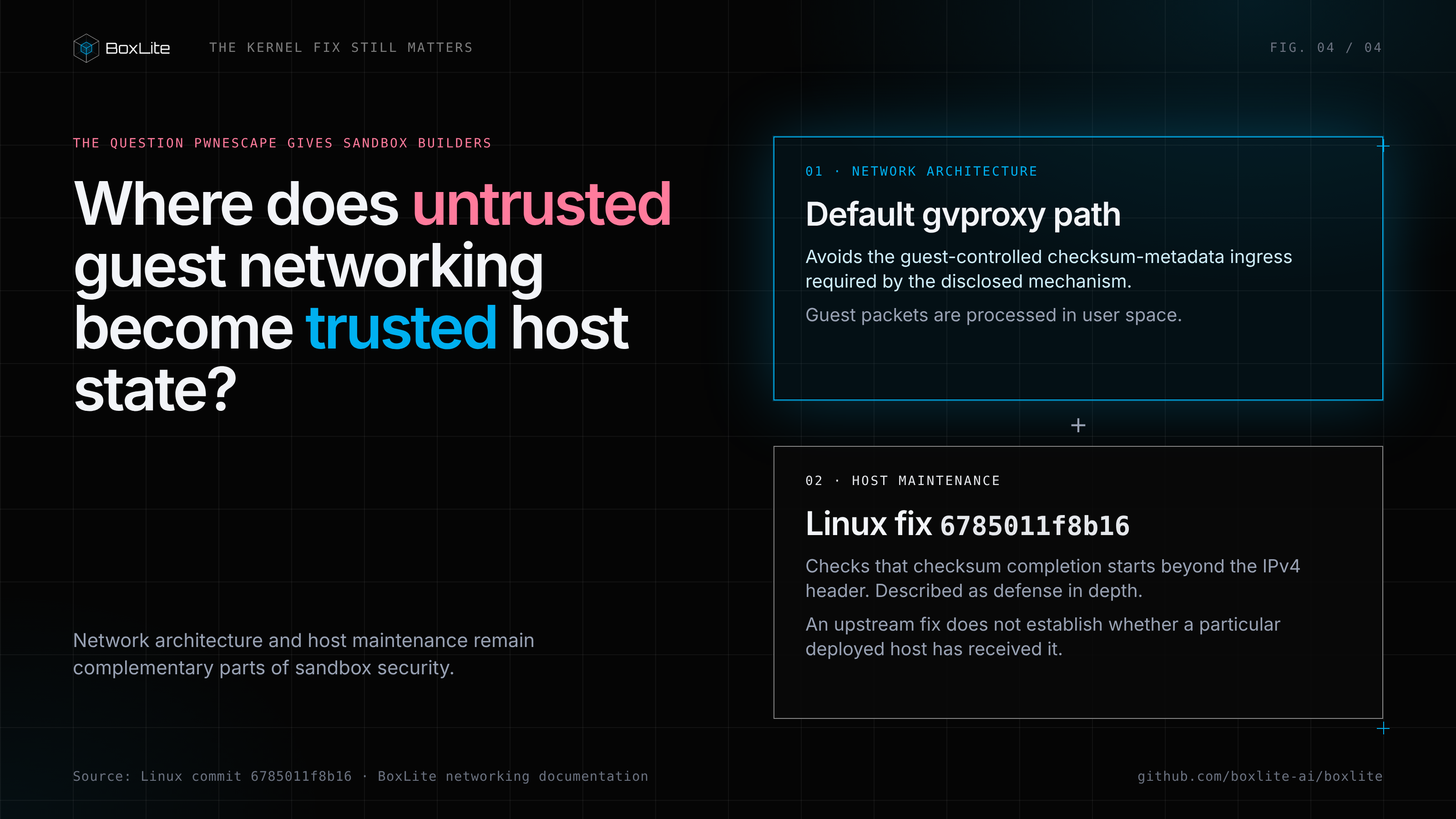
The accepted Linux fix, commit 6785011f8b16, checks that checksum completion starts beyond the IPv4 header before proceeding in several affected paths. The commit describes this as defense in depth and notes that broader input validation needs further work. Accepted Linux fix.
An upstream fix does not establish whether a particular deployed host has received the relevant patch. Network architecture and host maintenance remain complementary parts of sandbox security.
Built for the code an agent might run next
An AI agent can download dependencies, run generated scripts, and execute code its developer has never reviewed. Its sandbox needs boundaries across every interface exposed to that workload, including networking.
PwnEscape gives sandbox builders a useful question to ask: where does untrusted guest networking become trusted host state? For BoxLite, that question informs both the default network architecture and the ongoing review of its security boundaries.
Learn more about BoxLite and its networking architecture.
This does not imply BoxLite is without security vulnerabilities. Being open source, BoxLite receives generous support from security practitioners worldwide.
Acknowledgements
We thank everyone who has privately reported vulnerabilities to us:
- @alcls01111.
- @arpitjain099 (MIT).
- @EaEa0001.
- @GrosQuildu (Trail of Bits).
- @manus-use.
- @mileeeesW.
- @MR-pentestGuy.
- @ry2811 (UIT).
- @sanidipeiris-alt.
- @scadastrangelove (SCADA StrangeLove).
- @tikipiya.
- @XlabAITeam (Tencent Xlab).
- @Yanchon918s.
- @zaara2004 (ZeroX).